

The short answer
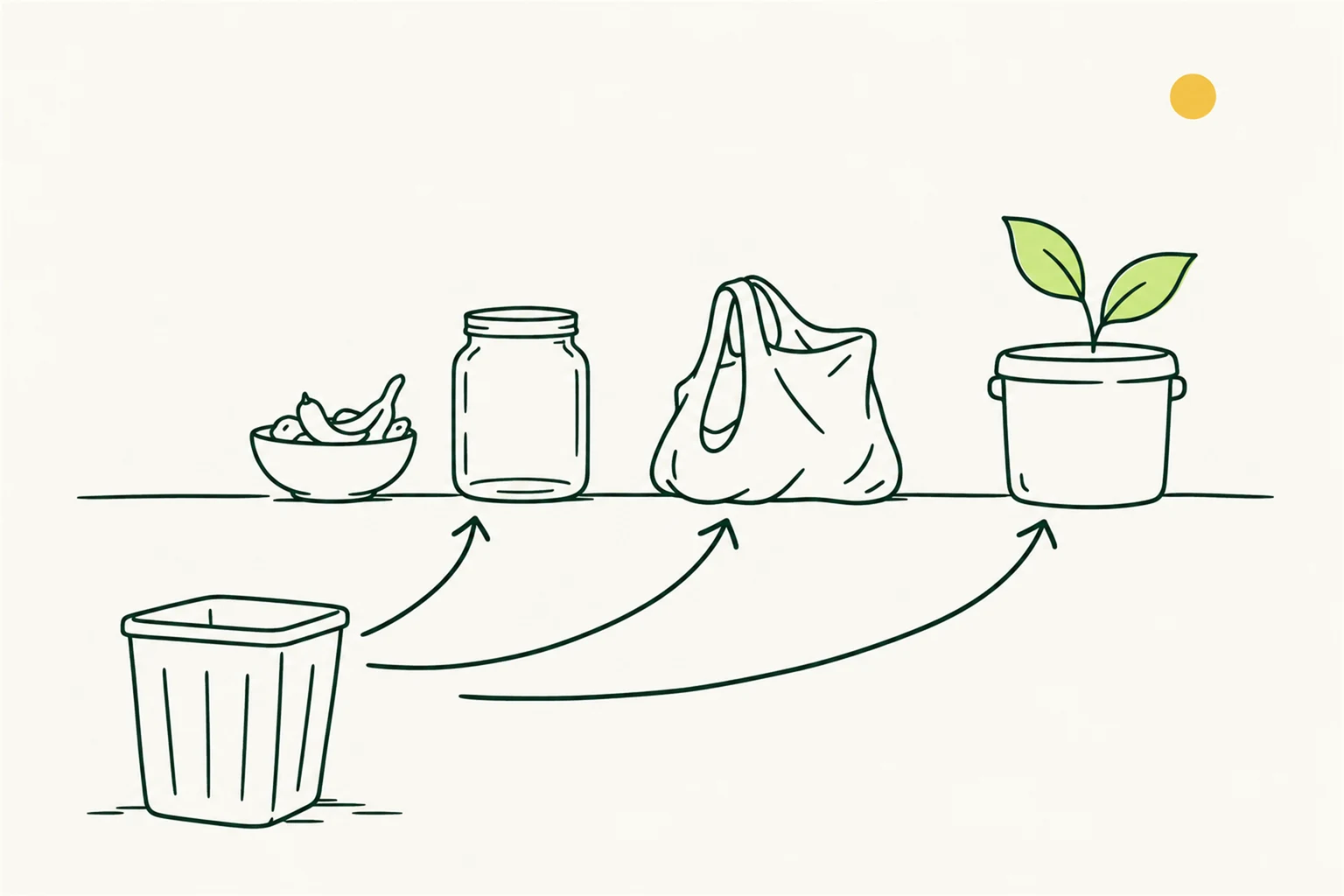
Before you throw something away, ask four questions in order: can I avoid creating this, can I use it again, can it be recycled or composted, and only then, how do I dispose of it safely? The US Environmental Protection Agency (EPA) ranks waste options in exactly that order, calling source reduction, also known as waste prevention, "the most environmentally preferred strategy". This guide turns that order into steps you can use at home this week.
Why household waste matters
The scale is global. UNEP's Global Waste Management Outlook 2024 estimates that the world generated 2.1 billion tonnes of municipal solid waste in 2023 and projects 3.8 billion tonnes a year by 2050, an increase of 1.7 billion tonnes. UNEP puts the direct cost of managing waste at USD 252 billion in 2020, rising to USD 361 billion once the hidden costs of pollution, poor health and climate change are counted.
The same report argues that prevention pays. Without urgent action, it projects an annual cost of USD 640.3 billion by 2050, compared with a net USD 270.2 billion if waste prevention and management measures are taken. These are global estimates, so they tell us why the order of options matters, not what your own bin will cost.
The order of options, step by step
| Step (EPA order) | The question to ask | What it can look like at home |
|---|---|---|
| 1. Source reduction and reuse | Do I need to create this waste at all? Can it be used again, by me or someone else? | Buy only what you will use. Reuse containers. Donate items in good condition. Repair before replacing. |
| 2. Recycling and composting | Can this be collected, sorted and made into something new? | Separate clean recyclable materials where a collection or buy-back exists. Compost food scraps and garden trimmings. |
| 3. Energy recovery | Can non-recyclable waste be turned into heat, electricity or fuel? | Mostly a decision for waste systems, not households. It comes after reuse and recycling. |
| 4. Treatment and disposal | How can what remains be disposed of safely? | Landfills are the most common form of disposal. Keep hazardous items such as batteries separate where there is a safe drop-off. |
Notice what happens at step 1: a decision made at the shop or in the kitchen avoids the work and cost of every later step. That is why the EPA lists reduction and reuse first.
Start with food
Food is often the easiest waste to cut because the decisions are daily and the savings are direct. UNEP's Food Waste Index Report 2024, summarised by UN News, found that 1.05 billion tonnes of food went to waste in 2022. Households accounted for 631 million tonnes, which is 631 divided by 1,050, or about 60% of the total. The report estimates that each person wastes 79 kilograms of food a year, that 19% of food available to consumers is wasted, and that food loss and waste generates up to 10% of global greenhouse gas emissions.
The same report found that higher-, upper-middle- and lower-middle-income countries differ in average household food waste by just seven kilograms per person per year. The larger gap it identifies is between urban and rural populations. In other words, this is not only a rich-country problem.
The EPA's advice for cutting food waste at home is practical:
- Plan meals and buy only what you need. Check the refrigerator, freezer and pantry before shopping.
- Keep the refrigerator at 40°F or below, which is about 4°C. Do not leave perishable food at room temperature for more than two hours.
- Store bananas, apples, pears, stone fruits and avocados away from other produce, because they release ethylene gas that can make nearby produce spoil faster.
- Wait to wash berries, cherries and grapes until you are ready to eat them, to prevent mold.
- Use food that is past its best in soups, stir fries and smoothies. Use stale bread and vegetable scraps, for example for croutons or stock.
- Donate untouched, safe, nutritious food where a food bank or community kitchen exists. Compost scraps that cannot be eaten.
Three worked examples
These are illustrations to show the method, not measurements of any real household.
- The average, scaled to a home. If every person in a household of five wasted the global average of 79 kg of food a year, the household would waste 5 x 79 = 395 kg a year. Divided across 52 weeks, that is about 7.6 kg a week. Your own number may be higher or lower, which is why a weekly log helps.
- Applying the order to a broken fan. Step 1 asks whether it can be repaired or the part replaced. If not, can someone else use the working parts? Only after those answers do you reach recycling, and only after that disposal.
- The two-hour rule. Cooked rice left on a counter from 1:00 pm is past the EPA's two-hour limit for perishable food at 3:00 pm. Composting it is safer than eating it, and it shows why the rule belongs in the plan: reducing waste never means taking a food safety risk.
A one-week household waste log
To find your own biggest waste stream, keep a simple log for seven days. Copy this and adapt it:
Day / Item thrown away / Roughly how much / Why? (spoiled, broken, packaging, no longer needed) / Could it have been avoided, reused or repaired? (yes, no, not sure)
At the end of the week, add up the "why" column. The reason that appears most often is where to start.
Then pick one change for the following week, such as planning meals before shopping or keeping a repair box. Small, repeated habits are easier to keep than a long list.
What this guide cannot tell you
Collection, recycling and composting services differ between cities and neighbourhoods, and we have not verified the services in your area. The EPA pages describe United States practice and are used here for the order of options and food-handling advice. The UNEP figures are global estimates. We do not claim savings for your household, and we do not recommend any recycling, composting or donation service. Check what is available locally, and ask your municipality or a local community group if you are unsure.
Key takeaways and quick answers
- Ask four questions in order: avoid, reuse, recycle or compost, then dispose.
- Households accounted for 631 million of the 1.05 billion tonnes of food wasted worldwide in 2022.
- Good food planning and storage are simple, low-cost ways to cut waste, and food safety limits still apply.
- A one-week log shows your own biggest waste stream.
For a related field guide, read the waste hierarchy at home, or see our Waste to Life project. If you have a practical tip that works in your area, tell us. We agree publication and credit with you before anything is shared.
Is recycling the first thing I should try?
No. The EPA ranks source reduction and reuse first, then recycling and composting, then energy recovery, then treatment and disposal. Preventing waste comes before sorting it.
Which household waste is easiest to cut?
Food is a good place to start. UNEP's Food Waste Index reports that households produced 631 million tonnes of the 1.05 billion tonnes of food wasted worldwide in 2022, up to 60% of the total.
Do I need special equipment to start?
No. A notebook, a week of noting what you throw away, and the questions in this article are enough. Local rules for collection, recycling and composting differ, so check what your area offers.